
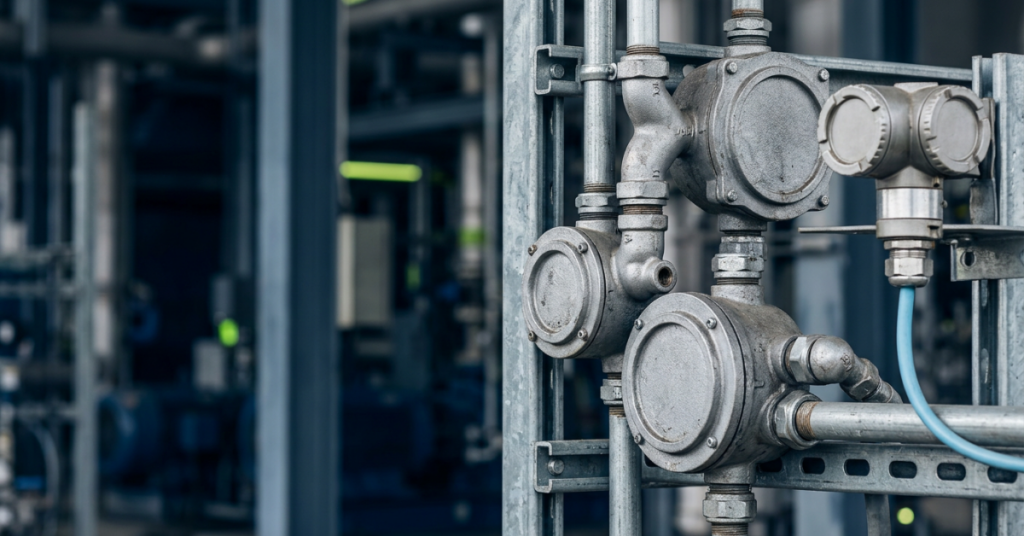
Explosion-Proof vs. Intrinsically Safe vs. Purged Enclosures: Choosing Protection Methods for Hazardous Locations
Explosion-proof and intrinsically safe are two different ways to prevent electrical equipment from igniting a flammable atmosphere. Explosion-proof equipment contains an ignition inside a heavy enclosure so it cannot spread to the surrounding gas. Intrinsically safe equipment limits the electrical energy in a circuit so low that it cannot cause ignition in the first place. Purged and pressurized enclosures take a third approach by keeping flammable gas out of the enclosure altogether.
Each method is recognized by the National Electrical Code (NEC) for use in Class I hazardous locations, but they differ in cost, weight, maintenance, and the kinds of equipment they can protect. Choosing the right method for each device is one of the most important decisions in designing electrical and instrumentation systems for oil and gas facilities.
Protection method selection starts with the area classification. If you need a refresher on Divisions, Zones, gas groups, and T-codes, start with our guide to hazardous area classification for oil and gas facilities.
How Explosion-Proof Equipment Works
Explosion-proof equipment does not try to keep gas out. It assumes gas will eventually enter the enclosure and be ignited by arcing contacts or hot parts. The enclosure is built strong enough to contain that internal explosion, and its joints and threaded openings are machined as flame paths that cool escaping gases below the ignition temperature of the surrounding atmosphere.
Where it fits: Explosion-proof protection is the standard choice for power equipment in Class I, Division 1 areas, including motors, motor starters, lighting fixtures, switches, and junction boxes. It is suitable for Division 2 as well.
What it requires:
- Threaded rigid metal conduit or intermediate metal conduit, or listed cable types such as MC-HL and TC-ER-HL with approved fittings.
- Conduit seals within 18 inches of enclosures that contain arcing or high temperature devices, and seals where conduit crosses a classified boundary, to stop gas and flame from traveling through the raceway.
- Threaded joints made up wrench tight with at least five full threads engaged.
- Covers and flame paths kept clean, undamaged, and free of paint, gaskets, or debris that the listing does not allow.
Trade offs: Explosion-proof enclosures are heavy and labor intensive to install, and every opening is a potential compliance issue. Equipment generally cannot be opened while energized in a classified area, which affects how maintenance and troubleshooting are planned.
How Intrinsic Safety Works
Intrinsic safety (IS) prevents ignition by limiting the voltage, current, and stored energy in a circuit so that no spark or hot surface can ignite the gas, even when there is a fault. An associated apparatus, usually a zener barrier or galvanic isolator mounted in the safe area or a suitable enclosure, limits the energy delivered to field devices in the hazardous area.
Where it fits: Intrinsic safety is suited to low energy instrumentation, such as pressure, temperature, and level transmitters, 4 to 20 mA loops, switches, and many analyzers and wireless devices. It is approved for Division 1, Division 2, and, with the appropriate rating, Zone 0. It is not practical for motors, heaters, or lighting.
What it requires:
- A control drawing that matches each field device to its barrier or isolator using entity parameters (voltage, current, capacitance, and inductance) so the loop stays within safe limits.
- Separation of IS wiring from non-IS wiring, typically at least 2 inches or a grounded metal partition, in panels and raceways.
- Clear identification of IS circuits. Light blue is the common color for IS wiring and terminals.
- Proper grounding or bonding of barriers as the manufacturer and control drawing specify.
Trade offs: Intrinsic safety usually lowers installation cost and allows live maintenance on field devices, but it depends on good documentation. A single unapproved substitution of a transmitter or barrier can take a loop out of compliance without anyone noticing.
How Purged and Pressurized Enclosures Work
Purging and pressurization keep flammable gas out of an enclosure, room, or building by supplying clean air or inert gas at a pressure slightly higher than the surrounding atmosphere. NFPA 496 defines three types:
- Type X: Reduces a Division 1 interior to unclassified.
- Type Y: Reduces a Division 1 interior to Division 2.
- Type Z: Reduces a Division 2 interior to unclassified.
Where it fits: Pressurization is used for equipment that cannot practically be made explosion-proof or intrinsically safe, such as analyzer shelters, control panels with PLCs and HMIs, variable frequency drives, and entire MCC or control buildings near process equipment.
Trade offs: Pressurized systems need a reliable air or inert gas supply, pressure monitoring, and alarms or automatic power shutdown when pressure is lost, depending on the type. They allow standard equipment inside but add mechanical systems that must be tested and maintained.
Nonincendive Equipment for Division 2
Nonincendive equipment and wiring cannot release enough energy to ignite gas under normal operating conditions. Unlike intrinsic safety, it is not evaluated under fault conditions, so it is only permitted in Division 2 and Zone 2 areas. Because most of the open process area at compressor stations, meter stations, and gas plants is Division 2, nonincendive instruments and lighting are widely used and can reduce cost compared with explosion-proof equivalents.
Side by Side Comparison
Method | How It Prevents Ignition | Allowed In | Typical Equipment | Live Maintenance |
|---|---|---|---|---|
Explosion-proof | Contains an internal explosion | Division 1 and 2 | Motors, starters, lighting, junction boxes | No, de-energize first |
Intrinsically safe | Limits circuit energy, even under fault | Division 1 and 2, Zone 0 (ia rated) | Transmitters, switches, 4 to 20 mA loops | Yes, on IS circuits |
Purged and pressurized | Keeps gas out with positive pressure | Division 1 or 2, by type | Analyzer shelters, control panels, MCC buildings | Depends on type and procedures |
Nonincendive | Limits energy under normal operation | Division 2 and Zone 2 only | Instruments, lighting, low energy devices | Yes, on nonincendive field wiring |
How to Choose the Right Protection Method
Most oil and gas facilities use a combination of methods. These questions help narrow the choice for each device:
- What is the classification? Division 1 and Zone 0 limit the options. Division 2 opens up nonincendive equipment and simpler wiring methods.
- How much power does the device need? Motors, heaters, and lighting generally need explosion-proof or pressurized protection. Low energy instruments are strong candidates for intrinsic safety.
- How often will it be maintained or calibrated? Devices that technicians service often are easier to maintain live on IS circuits.
- Can the equipment be located elsewhere? Moving MCCs, VFDs, and PLC panels outside the classified boundary, or into a pressurized building, often reduces the amount of protected equipment needed.
- What will the site standardize on? Consistent methods across a facility simplify spare parts, training, and inspections.
Installation and Inspection Practices That Keep Systems Compliant
The protection method only works if it is installed and maintained to its listing. Common issues found during inspections of classified areas include missing or unpoured conduit seals, loose or missing cover bolts on explosion-proof enclosures, damaged flame paths, mixed IS and non-IS wiring in the same panel, and field devices swapped without updating the control drawing. A documented inspection program, along with as-built drawings that reflect every change, keeps a facility compliant over its full life.
How Wikota Electrical Services Delivers Hazardous Location Work
Wikota Electrical Services installs electrical, instrumentation, and controls systems for oil and gas, pipeline, gas processing, and helium and cryogenic facilities across a 48-state footprint. Our crews install explosion-proof power systems, intrinsically safe instrument loops, and the seals, grounding, and documentation that go with them, backed by more than 80 years of combined team experience and a safety record of zero recordable incidents.
Through the integrated Wikota platform, we also coordinate with Wikota Fab Solutions on prefabricated skids and control buildings, so protection methods and classified boundaries can be accounted for before equipment ships to site.
Frequently Asked Questions
Explosion-proof equipment contains an explosion inside a strong enclosure so it cannot ignite the surrounding gas. Intrinsically safe equipment limits electrical energy so a spark or hot surface strong enough to cause ignition never occurs. Explosion-proof is used mainly for power equipment, and intrinsic safety for low energy instruments.
Neither is better in every case. Intrinsic safety is usually the more practical choice for instruments because it allows live maintenance and lighter wiring. Explosion-proof protection is needed for motors, lighting, and other equipment that uses too much power for an intrinsically safe circuit.
Yes. Intrinsically safe equipment and wiring are approved for Class I, Division 1 and Division 2 locations when installed according to the control drawing. Devices rated "ia" can also be used in Zone 0.
Intrinsically safe circuits do not require explosion-proof wiring methods. However, a seal or other barrier is still required where IS conduit or cable passes from a classified area to an unclassified area, to prevent gas from migrating through the raceway.
A Type Z purge, defined in NFPA 496, uses positive pressure to reduce the inside of an enclosure from Division 2 to unclassified. It allows general purpose equipment, such as a PLC or VFD, to operate inside a Division 2 area.
Nonincendive equipment cannot release enough energy to ignite a flammable atmosphere under normal operating conditions. It is permitted only in Division 2 and Zone 2 areas, where flammable gas is not expected during normal operation.
Inspection frequency is set by the facility's maintenance program, site risk, and environment, and harsh or corrosive conditions call for shorter intervals. Inspections should check cover bolts, flame paths, seals, conduit integrity, and that equipment ratings still match the area classification.