
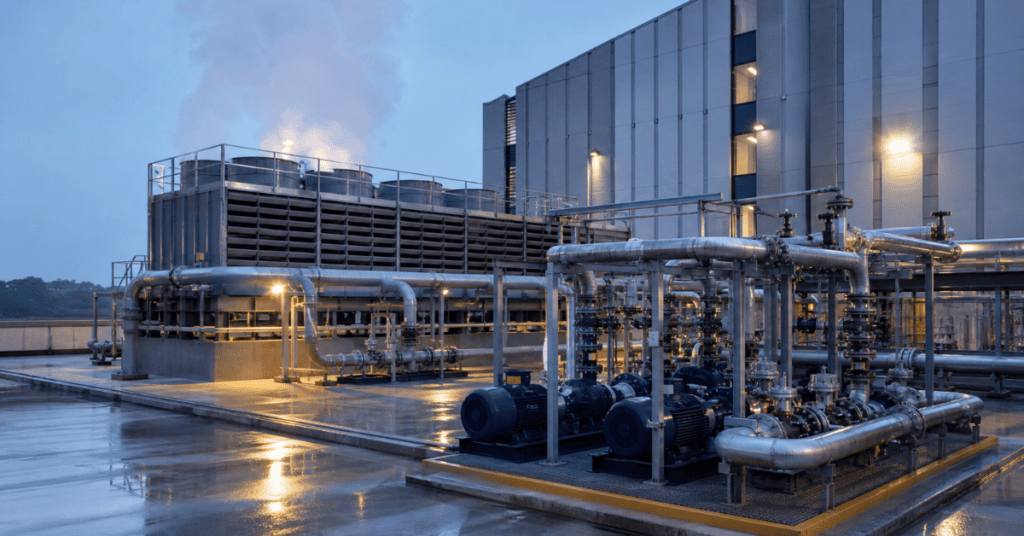
Cooling and Thermal Management Infrastructure for Data Centers
Data center cooling and thermal management infrastructure is the equipment and systems that remove heat from IT hardware and reject it outside the facility. It includes air cooling arrays, chilled water plants, cooling towers, dry coolers, closed-loop pump skids, and liquid cooling systems such as direct-to-chip and immersion, along with the power distribution and controls that run them. As compute density climbs, cooling has become a mission-critical system in its own right and one of the largest electrical loads in the facility.
Wikota Electrical Services installs, powers, and controls cooling infrastructure for data center projects, working alongside affiliates Wikota Design & Construction LLC and Wikota Fab Solutions LLC as one integrated EPC and fabrication platform.
Why Thermal Management Is Mission Critical
Every watt delivered to a server becomes heat that must be removed. As racks move to higher power densities to support AI and high-performance computing, the cooling system has less margin for error. Effective thermal management keeps hardware within safe operating temperatures, protects equipment life, and preserves the facility’s ability to support denser compute over time.
A cooling interruption can force equipment to throttle or shut down within minutes. That is why cooling is engineered with the same redundancy, protection, and controls discipline as the IT power path. Cooling demand also feeds directly into power planning, which is covered in Electrical Load Analysis, Power Island Design, and BESS Integration for Data Centers.
Data Center Cooling Methods Compared
| Cooling Method | How It Works | Infrastructure and Scope |
|---|---|---|
| Air cooling arrays | Fans and air handlers move cooled air through the data hall and exhaust hot air. | Array installation, fan power distribution, VFDs, and temperature controls. |
| Chilled water plants | Chillers produce cold water that circulates to cooling coils or liquid cooling loops. | Chiller installation, closed-loop pump skids, piping, MCCs, and plant controls. |
| Cooling towers | Evaporation rejects heat from the condenser water loop to the atmosphere. | Tower installation, fan and pump power, and controls. |
| Dry cooling | Air-cooled heat exchangers reject heat without evaporating water. | Dry cooler installation, fan power and VFDs, and controls integration. |
| Direct-to-chip (DTC) | Facility water loop, coolant distribution, pump skids, and leak and flow monitoring. | Dry cooler installation, fan power and VFDs, and controls integration. |
| Immersion cooling | Servers are submerged in a non-conductive dielectric fluid that absorbs heat. | Tank power, heat exchange loop, pumps, and fluid temperature controls. |
Cooling Infrastructure Capabilities
Air Cooling Array Installation
Air cooling remains the foundation for many data halls and supporting spaces. Wikota installs air cooling arrays for facilities where air-based cooling meets density and efficiency requirements, along with the power distribution, variable frequency drives, and controls that let fan speed follow heat load.
Chilled Water Plant Installation
A chilled water plant is the central heat-removal system for many large facilities. Wikota’s scope covers chiller plant installations, cooling tower installation, and closed-loop pump skids that the platform designs and fabricates in house. The electrical side includes medium- and low-voltage feeders, motor control centers, VFDs for pumps and tower fans, and the instrumentation that tracks temperature, pressure, and flow across the plant.
Dry Cooling and Direct-to-Chip (DTC) Immersion Cooling Support
Dry cooling rejects heat through air-cooled heat exchangers and reduces water consumption, which matters on sites with limited water supply or strict water use limits. Wikota supports dry cooling systems with installation, fan power, drives, and controls.
Direct-to-Chip and Immersion Cooling Support
Liquid cooling removes heat closer to its source than air alone, which makes it a leading option for high-density AI and HPC racks. There are two main approaches:
- Direct-to-chip (DTC) cooling circulates coolant through cold plates attached to processors, so liquid never touches the electronics.
- Immersion cooling submerges entire servers in a dielectric fluid that absorbs heat from every component.
Both depend on reliable pumps, heat exchange loops, and continuous monitoring. Wikota provides installation support for these systems as part of a facility’s broader cooling strategy, along with the power and controls that keep them running.
The Electrical Scope Behind Cooling Systems
Cooling equipment is only as reliable as the power behind it. On a typical data center cooling project, Wikota’s electrical scope includes:
- Power distribution: Medium- and low-voltage feeders, switchgear, transformers, and branch circuits serving chillers, pumps, towers, and fans. See Electrical Construction.
- Motor control: Motor control centers and VFDs that let pumps and fans match speed to cooling demand.
- Redundancy: Distribution designed so a single component failure does not take cooling offline.
- Engineering support: Power systems design and arc-flash analysis from concept through issued-for-construction packages through Engineering & Design.
On sites using on-site generation, cooling load is a direct input to power plant sizing. Learn more in Behind-the-Meter Power for Data Centers.
Fabrication Advantage for Cooling Skids
Closed-loop pump skids for chilled water systems are designed and fabricated in-house through Wikota Fab Solutions LLC, reducing field welding and supporting more predictable delivery timelines on cooling infrastructure scope.
Instrumentation and Controls for Cooling Systems
Cooling infrastructure depends on accurate instrumentation and controls to operate reliably. Wikota’s instrumentation and controls scope covers temperature, pressure, flow, and leak detection instruments, PLC and SCADA integration that ties cooling response to compute load, and loop checks, calibration, and commissioning support that bring thermal management infrastructure fully online.
Integrated Delivery From Design to Commissioning
Cooling projects cross civil, mechanical, electrical, and process disciplines. The Wikota platform brings in-house capability in all four, so design, fabrication, installation, and controls are coordinated by one team. Project Delivery covers pre-construction through startup, commissioning, and handover documentation.
- Experience: 80+ years of combined experience in engineering, design, and construction. Meet the Leadership Team.
- Safety: Zero incidents and zero recordables in company history, supported by an HSE program covering OSHA, NEC, NFPA 70E, and NEMA compliance. See Safety, Quality & Compliance.
- Access: A lean cost structure with direct access to leadership on every project.
- Reach: Electrical construction, instrumentation, and controls services across all 48 contiguous states.
Planning the fuel supply for a gas-fired site as well? See Last Mile Pipeline Interconnections for Data Center Power Plants.
Frequently Asked Questions - Cooling and Thermal Management Infrastructure for Data Centers
What cooling methods does Wikota install for data centers?
Wikota installs air cooling arrays, chilled water plants with closed-loop pump skids and cooling towers, and provides installation support for dry cooling and direct-to-chip immersion cooling systems.
What is direct-to-chip cooling?
Direct-to-chip (DTC) cooling is a liquid cooling method that delivers coolant directly to or near the chip generating heat, offering more targeted thermal management for high-density compute than traditional air cooling.
Does Wikota fabricate chilled water skids in-house?
Yes. Closed-loop pump skids for chilled water systems are designed and fabricated in-house through Wikota Fab Solutions LLC.
How does thermal management affect data center uptime?
Effective thermal management keeps compute hardware operating within safe temperature ranges. Inadequate cooling infrastructure increases the risk of equipment failure and unplanned downtime as compute density scales.
What is data center cooling and thermal management infrastructure?
It is the set of systems that remove heat from IT equipment and reject it outside the building, including air cooling, chilled water plants, cooling towers, dry coolers, pump skids, liquid cooling systems, and the electrical power and controls that operate them.
What is the difference between direct-to-chip and immersion cooling?
Direct-to-chip cooling pumps liquid through cold plates attached to processors, so coolant never touches the electronics. Immersion cooling submerges entire servers in a non-conductive dielectric fluid that absorbs heat directly from every component.
Designing cooling infrastructure for a data center project?
Contact Wikota Electrical Services to discuss your thermal management scope.